Why behaviour still breaks down — even when learning is in place
Over the past years, organisations have invested heavily in learning — programmes, frameworks, capability models — all built on one assumption: that behaviour will follow.
And to a certain extent, it does.
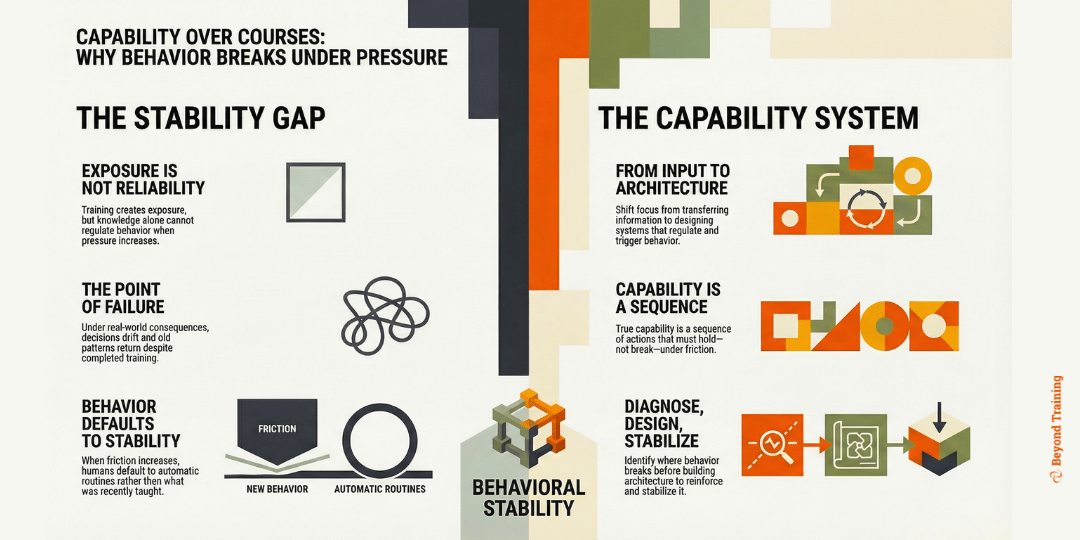
But the picture changes the moment conditions are no longer controlled.
In training environments, behaviour looks stable. Expectations are clear, attention is focused, and the “right” actions are easy to reproduce.
In reality, that stability does not always hold.
When pressure increases, priorities compete, or decisions carry real consequences, behaviour starts to shift. What seemed clear before becomes less consistent — and the gap between knowing and doing becomes visible.
This is not a problem of knowledge. It is a problem of stability.
Because behaviour holds as long as the environment supports it. But once that support weakens, you start to see the cracks:
- decisions drift
- priorities shift
- old patterns quietly return
Nothing dramatic — but enough to affect performance. And this is usually the moment organisations respond by adding more learning. Which makes sense — but doesn’t always solve the issue. Because the real question is not how behaviour is learned.
It is whether it can hold.
And that is where the focus needs to shift.
From learning as input…
to behaviour as something that must remain stable across real conditions.